Most modern laptops come with the keyboard backlight feature. This feature helps to work in a low-light environment. But in some cases, this feature may be turned off or may not work due to various reasons. Few of you may think about how to enable the keyboard backlight feature, and this article helps to find a way. There are different methods to enable, a few of them are using windows mobility centre, using keyboard hotkeys, etc. Let us learn in detail how to enable this feature.
Disclaimer-Hardware limitation: Backlight feature for keyboards is not available on all Windows laptops. Almost all the premium laptops have the backlight option, but the entry level laptops may not have this feature. Check whether this feature is available directly from your manufacturer’s website. If you are not seeing the backlight feature option in the Settings, your device may not support it.
Method 1 – Enable Keyboard Shortcuts to Activate Backlight
Most of the Laptop manufacturers provides direct firmware or hardware level control for controlling the backlight key brightness. Toggling the particular key combinations, like Fn+Spacebar on a Lenovo laptop, you can switch between different backlight brightness.
Step 1 – Look closely on the Functional key series. Look for the backlight brightness (🔅) icon there.
Step 2 – Now, press the Fn+that key brightness key to change different level of brightness on your system.
Here is the complete list of typical keyboard shortcuts for all the laptop brands –
| Brand | Hotkey Combo(s) | Notes |
|---|---|---|
| HP | Fn +F5, Fn+F9, Fn+F11, Fn+Spacebar | It may vary model to model (Pavilion, Envy, Omen). |
| Dell | Fn+F10, Fn+F6, Alt+F10, Fn+→ | Inspiron/XPS models use the ⇾ F10 |
| Lenovo | Fn+Spacebar | Typical across the range of ThinkPad, IdeaPad, Legion, LOQ. |
| ASUS | Fn+F3/F4, Fn+F7 | ZenBook and ROG series uses F4/F3 combo. |
| Acer | Fn+F9/F8 | Typical across the Aspire, Swift, and Predator models. |
| MSI | Fn+F8 | Most SteelSeries keyboards supports this combination.
Advanced controls via the MSI Center/SteelSeries Engine software. |
| Samsung | Fn+F9 | Common for Galaxy Book range. |
| Microsoft Surface | No hotkey | Automatic control or Surface app controlled. |
| Toshiba (limited support) | Fn+Z | Very limited availability. |
Try these combinations according to your laptop manufacturer.
Method 2 – Control the Backlight keyboard by Software
The backlight on keyboards can be controlled by OEM-specific softwares like Lenovo Vantage, HP Omen Command Center, Asus Armory Crate, etc.
NOTE – This feature is supported on specific models and the apps may not be supported on your device. Please check and confirm using the model number from the laptop manufacturer’s website.
Here are the list of complete list of possible OEM softwares for the popular brands from where you can control the backlight on your system –
HP – Omen Gaming Hub, HP Command Center / HP Omen Command Centre (for HP Omen series) for controlling light. You may use the Light Studio for control all of your HP Omen components.

Lenovo – Lenovo Vantage / Lenovo Legion Spectrum (for Legion series)
ASUS – For TUF, ROG series laptops, you can use MyASUS/ASUS Armoury Crate
Acer – Acer PredatorSense (for Predator series)
MSI – Theme switching and light sync options are available in MSI Center can be used for setting up keyboard lights.
Microsoft Surface – Surface App for the latest version of Surface Books.
Razer – Razer Synapse tool for all Razer laptops, keyboards, mouse
Gigabyte/ AORUS – Fusion RGB is used for keyboard backlight customization on the Gigabyte devices. Check your version and compatibility
Alienware – Alienware Command Center can be used for RGB lighting customizations
Instructions to use these softwares –
Step 1 – Simply download the app from the official website.
Step 2 – Install it on your device.
Step 3 – After installation, you can tweak the backlight brightness settings easily from the particular software.
This way, you can control the level of backlight on your keyboard.
Method 3 – Activate Backlight from BIOS
The backlight settings can be controlled from the Backlight settings in the system BIOS.
Step 1 – Restart your computer.
Step 2 – While the machine is booting up, press-hold the corresponding key such as F2, Delete, Esc, F10 (varies with the manufacturers) to boot up the BIOS/UEFI mode.
Step 3 – Once you are in the BIOS Settings page, open the Keyboard settings.
Step 4 – Then, you can manage the backlight settings from there. Enable the backlight settings in there and save the changes.
After saving the changes in BIOS, let the device restart normally. This way, you will get the backlight keyboard on your system.
Method 4 – Windows Mobility Center
This is an old method that may or may not work on your Windows device.
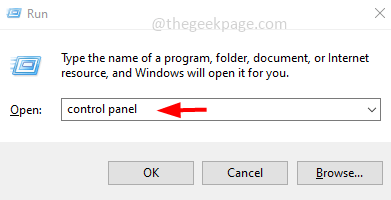
Step 1: Open the run prompt using Windows + R keys together. Type control panel and hit enter.
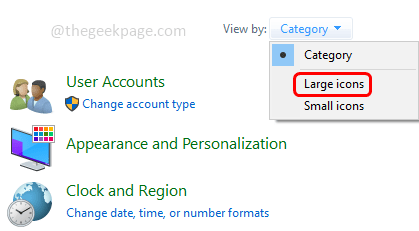
Step 2: From the View by dropdown which is on the right, select Large icons.
Step 3: Find Windows Mobility Center and click on it.
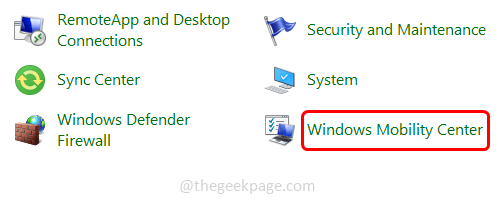
If you don’t see the Windows Mobility Center there, it may be hidden on your device.
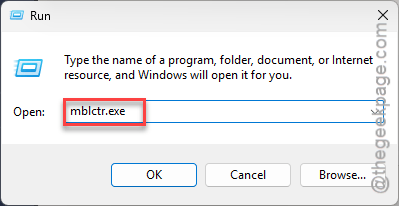
1. To open it up, press Win+R keys together.
2. Then, paste this shortcut and hit Enter.
mblctr.exe
Step 4: In the list of menus, find the keyboard Backlighting, and move its slider towards the right to increase the brightness.
Step 5: To access the additional options, click on the keyboard Backlighting box and make sure that keyboard lighting is On by clicking on the radio button beside.
Step 6: Also set the brightness level as bright or as per your need under keyboard brightness.
Step 7: When the laptop is inactive, the backlights will auto-off. You can set the time for auto-off or choose never off if you don’t want the backlights to off.
Step 8: For this, click on the drop-down under Settings for keyboard lighting and select the never off option.
Step 9: Once done with the changes, click on OK.
This way, you can control the keyboard lighting on your device.